 RelayDM
“Welcome DM” can describe an opening after a customer message, a response to a comment or a new-follower feature. Those are not interchangeable triggers. Before promising an automatic greeting, identify which event your account and tool are actually allowed to use.
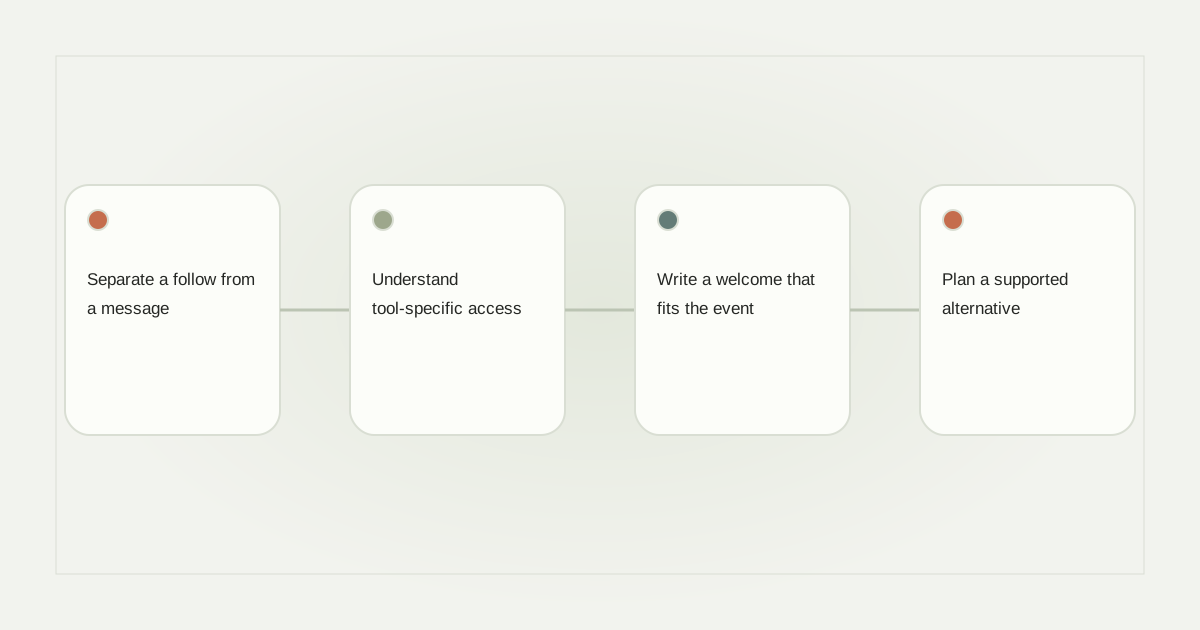
Separate a follow from a message
Someone following an account shows interest, but it does not establish that every app may immediately start any conversation it wants. Avoid tutorials that turn a follower list into a bulk-messaging list. Ask for the specific supported trigger, account eligibility and recipient requirements.
A resource-request opening is different. If a person comments on a post offering a guide, the appropriate private-reply path may apply. Meta’s documentation describes that path; it should not be relabelled as universal permission to welcome all followers.
Understand tool-specific access
Manychat documents a Follow to DM beta with Meta-controlled account eligibility and a specified onboarding requirement. Its availability is not evidence that another app has the same access. Nor should a reader assume that upgrading a plan necessarily changes Meta’s eligibility decision.
This distinction matters when comparing vendors. A product may truthfully advertise a capability that only some connected accounts can enable. Ask to see the current eligibility result for your actual account before committing to a campaign built around it.
Write a welcome that fits the event
For a person who voluntarily messages “CLASSES,” an eligible response might be: “Thanks for asking about classes. Would you like the current timetable?” For a requested guide, name the guide. For a genuinely supported new-follower feature, keep the welcome modest and make the next action optional.
Do not imply that the recipient requested a discount when they only followed. Avoid a chain of unrelated prompts immediately after a greeting. A useful welcome tells someone where they are and what they can choose next, without pretending an automated message is a personal conversation.
Plan a supported alternative
If the new-follower trigger is unavailable, invite people to initiate an eligible interaction. A profile or post can clearly explain how to request a public resource. This is a different journey, not a hidden workaround for a rejected permission.
For example, a music teacher can place “Message TIMETABLE for current lessons” in an appropriate invitation, then assess the supported inbox workflow. The template guide helps keep the opening concise. The comment guide covers a post-specific alternative.
Ask the vendor specific questions
Ask which event starts the flow, whether your connection method qualifies, what a recipient must do before later messages and what happens if eligibility changes. Request evidence of actual delivery and interaction, not just a preview or a successful HTTP response.
RelayDM does not presently claim a public universal new-follower welcome feature, and general customer sending remains gated. Review current product availability and keep a blocked feature blocked until its actual provider context qualifies. A transparent supported alternative is better than an unsupported promise. Keep a dated note of the trigger and eligibility result, and review it before launching a new campaign after any connection change.
Sources and editorial notes
Source review: November 1, 2026. This is research-based guidance, not an independent hands-on test of every product. Prices and permissions can change.
Read our methodology, product-availability policy and corrections process.