 RelayDM
Instagram DM automation is not automatically safe or unsafe because a vendor uses the word “official.” Evaluate how account access is granted, which recipients are contacted, what the workflow does after an error and who can stop it. A legitimate API connection reduces some risks, but it is not a guarantee against restrictions or poor customer experiences.
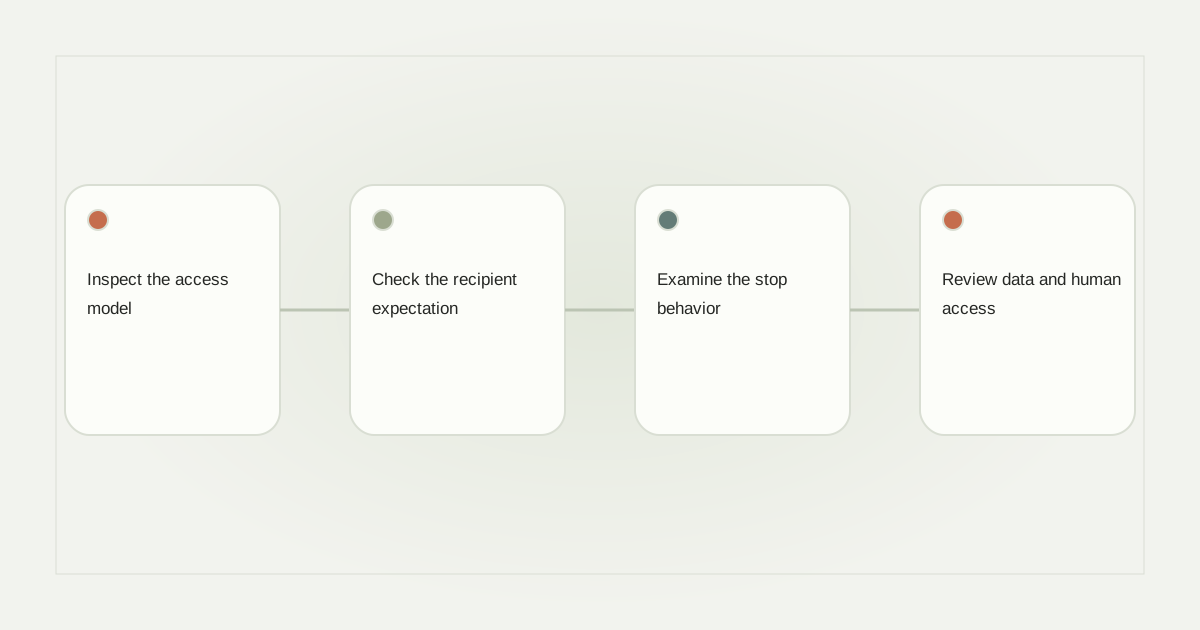
Inspect the access model
Begin by asking how the tool connects. Review the actual authorization screen and the permissions requested. Be cautious about software that asks you to hand over your Instagram password or run unexplained browser actions. An account owner should understand which application has access and how to revoke it through the supported account controls.
Meta’s Instagram Login profile documentation describes a permissioned API context. That does not mean every tool has every permission, or that every connected account qualifies for every feature. Ask the vendor to identify a missing permission rather than recommending repeated reconnects without evidence.
Check the recipient expectation
Compare two invitations: “Comment PACK for the packing checklist” and “Tell us your worst travel experience.” The first describes a resource request. The second invites conversation and may include sensitive personal details. Applying the same resource campaign to both posts would ignore what people expected when they commented.
Keep the opening message tied to that request. Do not turn one resource interaction into unsolicited daily promotions. A supported technical interaction and an appropriate basis for future marketing are separate questions. Seek relevant professional advice for your own privacy obligations; this checklist is operational guidance, not legal clearance.
Examine the stop behavior
Ask what happens after a revoked connection, expired permission, ambiguous send result or paused automation. A safe system should not keep retrying blindly. It should distinguish work that has not been sent from work whose provider outcome is uncertain. Operators need an understandable way to stop future processing.
Consider a hypothetical campaign capped at twenty requested conversations. If the service loses its network connection after submitting a message, a fresh attempt may create a duplicate. Ask how the product preserves the original event and prevents another send until the uncertainty is resolved. A visible counter alone does not answer that question.
Review data and human access
List the information collected: Instagram identifiers, messages, link activity and any volunteered contact details. Decide which team members genuinely need each field. Exports should not become an uncontrolled copy of every conversation. A freelancer helping with captions may not need access to leads or account administration.
Plan a human handoff for complaints, unusual questions and requests to stop. Automation should not create a loop when it cannot understand a response. Our lead-capture guide explains how to keep the collection purpose narrow.
Make a go-or-no-go record
Before launch, record the intended trigger, eligible audience, message sequence, destination, cap, stop control and responsible operator. Test a small authorized interaction and inspect the actual outcome. Do not claim safety from a preview, a sales badge or an unsupported “no bans” promise.
Review platform boundaries alongside this checklist. RelayDM does not currently offer unrestricted customer sending; its billing and delivery gates remain meaningful. Use the availability and pricing page to evaluate the product as it exists, not as a promise of future permissions.
Sources and editorial notes
Source review: November 1, 2026. This is research-based guidance, not an independent hands-on test of every product. Prices and permissions can change.
Read our methodology, product-availability policy and corrections process.