 RelayDM
Instagram cold-DM automation is not the same workflow as fulfilling a resource request. A comment campaign begins with a defined action around a particular post; a messaging conversation has its own eligibility requirements. Neither should be stretched into a tool for automatically contacting arbitrary profiles or treating a follower list as a list of consenting recipients.
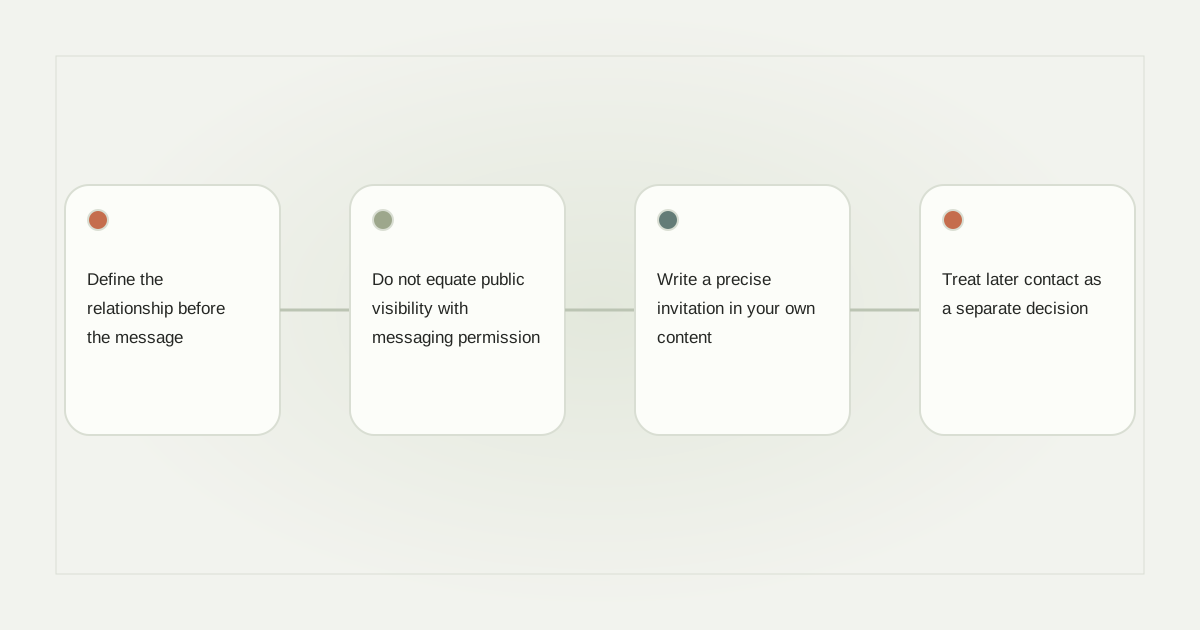
Define the relationship before the message
Imagine a ceramic artist offering a glazing guide. Someone commenting GUIDE is asking for a specific resource in that context. A different person who follows the artist, likes an old photo or appears in a competitor’s audience has not necessarily made that request.
Write down why the person expects the message and what it will contain. If that explanation depends only on “they might be interested,” you are designing a prospecting campaign rather than the narrow requested-resource journey described in this journal.
Do not equate public visibility with messaging permission
A public username or biography is not a general authorization for every integration to contact that person. Likewise, a tool’s ability to display an audience list does not establish permission for a particular message operation.
Use the actual documented API context. Meta’s private-reply and messaging rules distinguish operations and recipient interactions. Avoid products that describe a scraped list plus a delay slider as equivalent to an authorized inbound conversation. A slower unsolicited process does not become a requested resource exchange.
Write a precise invitation in your own content
If you want people to request a guide, make the offer understandable: “Comment GLAZE for the beginner materials checklist.” Explain any payment, sign-in or other material requirement before the recipient reaches the destination. A clear invitation makes the expected scope easier to honor.
Keep the follow-through equally narrow. Do not replace the guide with a sales call booking form unless that was the stated offer. The goal is to deliver what was requested, not use one interaction as an excuse for a long sequence of unrelated promotions.
Treat later contact as a separate decision
Receiving a resource does not automatically mean the person wants future marketing, a phone call or a transfer to another platform. Ask a relevant optional question only where the messaging context permits it, and respect a decline or lack of interaction.
Do not try to reopen expired eligibility by disguising promotional content as support. The design should stop when the required authorization or messaging window is absent. A system that fails closed is protecting the relationship, not merely reducing the campaign’s apparent reach.
Use qualification evidence instead of growth claims
For a permitted workflow, verify the signed incoming event, exact account association, actual provider response and recipient experience. A screenshot of a button or a promise of safe unlimited sending is not that evidence.
Read welcome-style templates for tone after a qualifying interaction, platform limitations for scope and comment-to-link design for the resource path. These guides deliberately separate an invitation from unrestricted outbound outreach.
Choose the workflow you can justify
If the account or recipient does not qualify, use an honest public information route or an appropriate human process. Do not manufacture interaction evidence or click through another person’s account. RelayDM’s customer-wide sending remains gated; review current availability rather than interpreting its Builder as a cold-outreach product. No growth target removes provider or recipient requirements.
Sources and editorial notes
Source review: November 1, 2026. This is research-based guidance, not an independent hands-on test of every product. Prices and permissions can change.
Read our methodology, product-availability policy and corrections process.