 RelayDM
Instagram automation for a small business should remove one repeated task without making the rest of the business harder to run. Start with a bounded resource request or simple acknowledgement, assign a human owner and keep exceptional questions out of an unattended loop. The goal is a manageable process, not maximum automation.
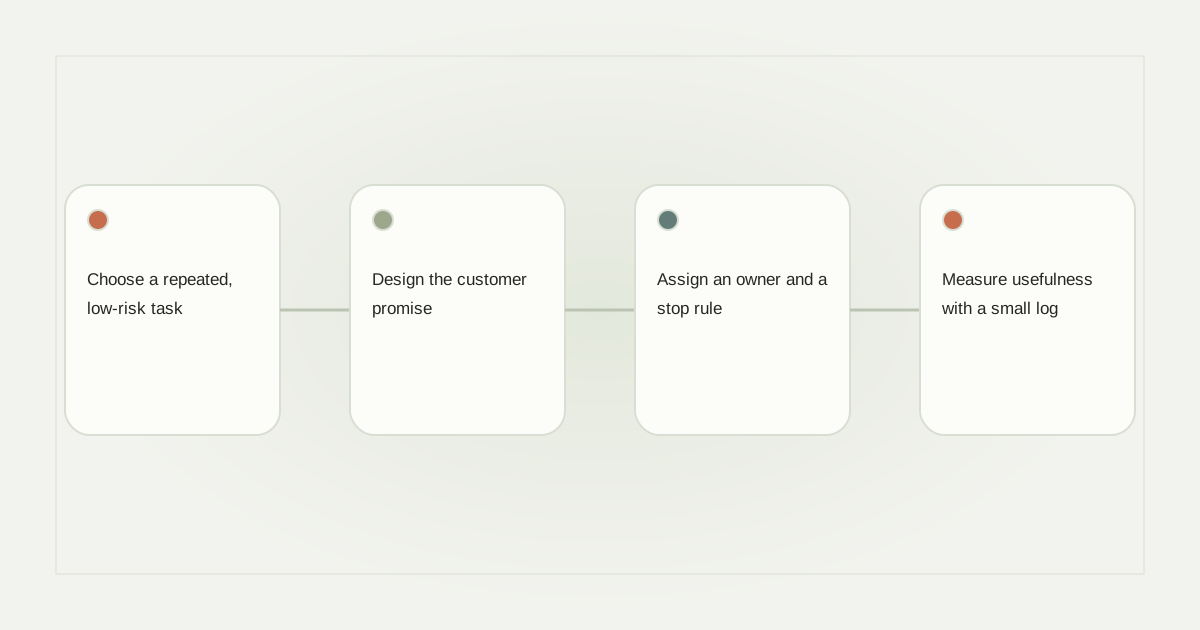
Choose a repeated, low-risk task
Review recent enquiries and identify a genuinely repetitive need. A florist might repeatedly share bouquet-care instructions; a studio might share a public class timetable. Choose information that stays useful and does not require a custom judgement about each customer.
Avoid starting with complaints, sensitive personal advice or promises about live stock you cannot verify. Write the answer source first. Keep its owner and review date visible internally so a seasonal change does not silently invalidate the response. If the source itself is incomplete or out of date, automating access to it will reproduce the problem faster.
Design the customer promise
For the florist, a Reel could invite viewers to request a care card. The message and destination should deliver that card, not lead unexpectedly to a paid bouquet offer. Any optional contact request needs a clear separate purpose.
Meta’s private-reply rules govern comment-started conversations. A request is not permission for an unlimited reminder sequence. Use our resource planning guide to keep the invitation, asset and next action aligned.
Assign an owner and a stop rule
Name the person responsible for the source page, the automation configuration and unanswered questions. In a two-person business, those may be the same person, but the responsibilities should still be explicit. “The software handles it” is not a handoff plan.
Define a stop condition before launch: a wrong destination, connection failure, uncertain send or a burst of complaints should trigger review. If the tool supports a genuine server-enforced cap, set it thoughtfully. A frontend counter is not a substitute for reliable enforcement.
Measure usefulness with a small log
Track the customer task, its outcome and the reason for human escalation. A practical weekly log could record whether people found the care instructions useful and which questions still needed a person. Do not call every comment a lead or every resource visit a sale.
Compare the same task before and after a legitimately enabled workflow. Record staff time only if measured, and avoid invented savings. The analytics guide helps separate provider acceptance, recipient action and customer outcome.
Buy for current capability
Check plan limits, account access, renewal terms and actual sending eligibility before committing. A business needs a workflow it can operate today. An attractive editor and a low introductory price do not prove that its customer delivery path is open.
RelayDM offers an eligible seven-day trial, not a permanent free plan. Its public qualified UPI trial checkout remains separate from restricted payment methods, and general customer DM sending is still gated. Use current availability to evaluate it honestly. Prepare a clean draft and resource while waiting, but do not tell customers an automated service is live until the required production capabilities genuinely qualify.
Sources and editorial notes
Source review: November 1, 2026. This is research-based guidance, not an independent hands-on test of every product. Prices and permissions can change.
Read our methodology, product-availability policy and corrections process.