 RelayDM
Instagram comment moderation and automated replies solve different problems. Moderation decides how a public conversation is handled. A reply answers or acknowledges someone. A keyword match should not silently become permission to hide criticism, and removing a comment should not be treated as proof that a resource message was delivered.
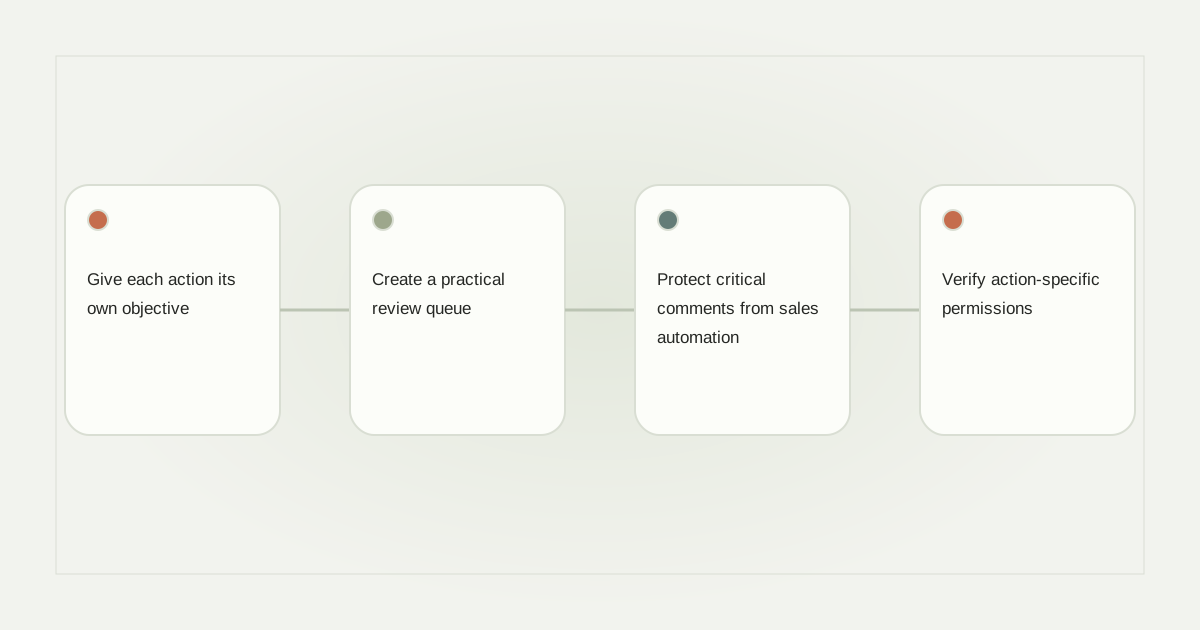
Give each action its own objective
A café receives “MENU,” a complaint about a delayed order and an abusive remark under the same Reel. The menu request may fit a narrow resource workflow. The complaint needs a responsible human response. The abusive remark may need review under the café’s moderation policy.
Write these as separate decisions. Do not route every comment containing a common word into a promotional DM while also applying an unrelated hide or delete rule. The same event can be relevant to several systems, but each action needs its own reason, authority and audit trail.
Create a practical review queue
Define categories staff can actually distinguish: requested resource, ordinary question, service issue, suspected spam and material requiring urgent review. A category should lead to an owner and a response expectation, not just a colored label.
Keep uncertain cases visible. Sarcasm, multilingual phrases and quoted language can defeat simplistic rules. If a system cannot confidently distinguish an insult from a customer quoting an earlier message, send the case to review rather than assuming a public removal is harmless.
Protect critical comments from sales automation
A customer saying “I never got the link and nobody answers” contains the word LINK, but the immediate task is recovery. Build explicit review for complaints and avoid implying that a cheerful automated acknowledgment has resolved the issue.
Prepare short human handoff copy: “We’d like to check this. Please use the support contact in our profile without posting your order details here.” That keeps private information out of the public thread and makes responsibility clearer. It is an example, not a guarantee that a particular moderation feature exists in RelayDM.
Verify action-specific permissions
Do not infer permission to moderate because a tool can send a private reply. Ask the vendor which exact action it supports, which account context qualifies and how it records failures. Meta’s private-reply documentation describes a messaging operation; it should not be stretched into an undocumented moderation promise.
In a permitted test environment, check that a failed messaging action does not change the comment’s moderation status. Likewise, confirm that a paused reply automation does not unexpectedly stop the team’s separate review process.
Review the public wording as carefully as the rule
A public response can acknowledge a request without announcing private details. “Your requested guide is on its way” is appropriate only when the actual delivery process supports that statement. If evidence is pending, avoid a definitive success claim.
See automatic public replies for the reply workflow and keyword rules for matching decisions. Keep moderation and reply metrics separate: fewer visible complaints is not evidence of better customer service.
Document who may stop or override automation
Staff need a visible pause procedure and a way to leave a reason for a manual decision. Review several recent exceptions rather than only the easiest resource requests. Use the comment automation guide and current RelayDM capability information to evaluate the supported scope. Never purchase or enable a feature merely because moderation and messaging share a dashboard.
Sources and editorial notes
Source review: November 1, 2026. This is research-based guidance, not an independent hands-on test of every product. Prices and permissions can change.
Read our methodology, product-availability policy and corrections process.