 RelayDM

RelayDM versus Chatfuel is partly a question of channel scope. An Instagram resource campaign and a multi-channel customer operation may require different tools, people and budgets. This RelayDM-authored comparison uses official public positioning and does not claim independent firsthand testing or automatic feature parity.
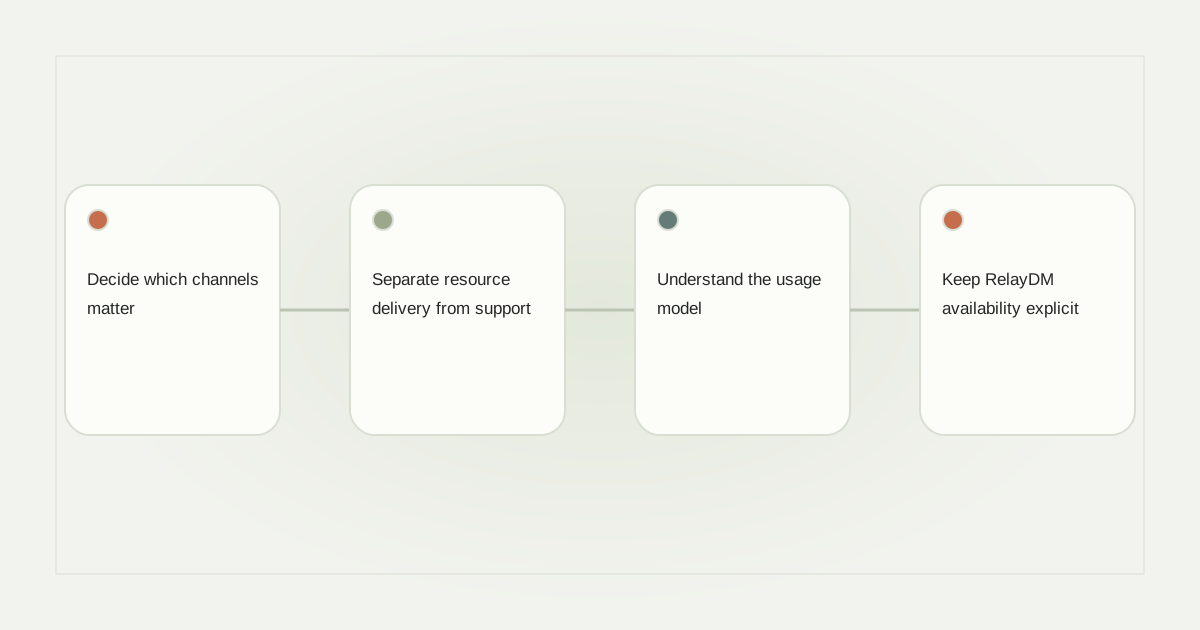
Decide which channels matter
Chatfuel’s official site presents broader chat and AI-related capabilities across channels. Verify the current plan and provider requirements for each channel you actually need. A channel appearing in a menu does not prove that every messaging action is eligible for every business.
RelayDM is focused on its Instagram workflow and existing dashboard. Do not assume that a resource editor includes an equivalent WhatsApp support operation, website agent or multi-channel inbox. List non-negotiable channels before comparing plans so an important gap does not emerge after purchase.
Separate resource delivery from support
A coach might need a sample lesson delivered after a requested comment. A retailer might need order enquiries, returns and team assignment across several channels. The first task can be described with a short sequence; the second requires a broader operating process and potentially integrations.
Use a sample conversation for each task. Ask how the product recognizes the request, how it handles an unexpected question and who owns the handoff. Do not use the successful delivery of a PDF as proof that the same product can safely resolve order disputes.
Understand the usage model
Chatfuel’s current pricing material includes AI-credit and usage considerations. Read the actual offer rather than relying on old flat-price summaries. Identify the unit, included amount, overage behavior and any separate channel/provider costs before estimating a month.
A practical worksheet should separate predictable resource conversations from open-ended support chats. They can consume different effort and usage. Keep unknowns visible, and compare monthly-billed commitments with annual totals rather than treating an annual equivalent as a monthly payment.
Keep RelayDM availability explicit
RelayDM has a seven-day eligible-account trial, not a free-forever plan. Public qualified UPI trial checkout is available, while cards, eMandate, Dodo Live, returning immediate-paid checkout and native financial plan mutations remain restricted. General customer Instagram sending and AI are not publicly qualified.
That means RelayDM’s Builder should be evaluated as a current configuration experience with meaningful gates, not as a claim to replace every Chatfuel operation immediately. A bounded native-button test is evidence for that test, not a broad commercial deployment guarantee. Ask which part of your own task remains unavailable, and keep that limitation in the decision record rather than assuming a future release will resolve it.
| Required work | RelayDM scope today | Chatfuel evaluation |
|---|---|---|
| Instagram resource configuration | Builder available; general customer delivery gated | Verify the exact trigger and rendered interaction |
| Other channels | Do not assume equivalent multi-channel support | Check each channel’s plan and provider requirements |
| AI handling | Not publicly qualified | Evaluate answer boundaries, usage and human escalation |
| Commercial commitment | Eligible seven-day trial; payment restrictions remain | Inspect current credit model, cadence and full offer |
Compare one owned customer task
Assign an operator, define a limited acceptance task and inspect real provider evidence where testing is authorized. Check correct account association, recipient interaction, expected resource, no duplicates and an independent stop. Keep platform restrictions intact; neither vendor’s pricing page overrides them.
Read the Chatfuel alternatives framework when broader channel needs dominate, and the cost guide for usage comparisons. Check RelayDM’s availability before deciding. The best fit follows your required task and support capacity, not the length of a feature list.
Sources and editorial notes
Source review: November 1, 2026. This is research-based guidance, not an independent hands-on test of every product. Prices and permissions can change.
Read our methodology, product-availability policy and corrections process.