 RelayDM

Manychat pricing in India requires two checks: which subscription offer applies to your account, and what your payment will actually cost in its billing currency. A blog’s converted rupee figure is not a checkout quote. Start with the current official offer and keep conversion, tax and usage assumptions visible.
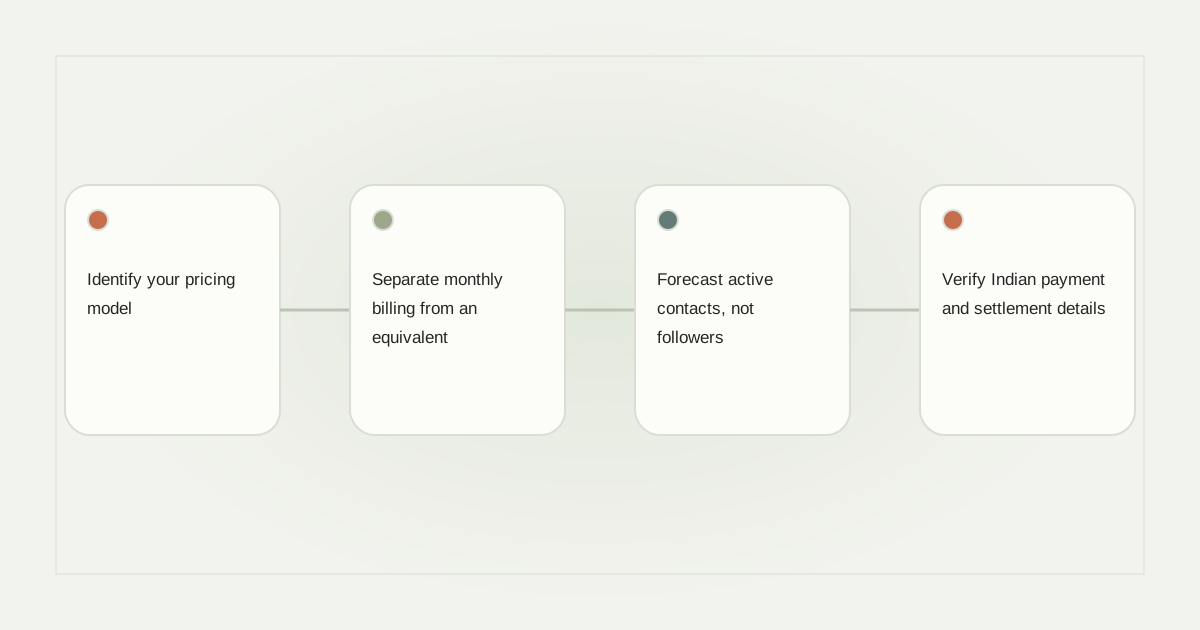
Identify your pricing model
Manychat’s subscription guidance describes a newer model introduced in 2026 alongside account and regional differences. Do not assume that a friend’s old account, a dated video and your new account show identical terms.
Open the official pricing page and compare it with the billing screen in your own account. Record the plan name, currency, allowance and billing cadence together. If they differ, resolve the offer with Manychat before relying on a third-party comparison.
Separate monthly billing from an equivalent
An annual plan may display a monthly equivalent while collecting an annual total. Treat that as a different commitment from a monthly subscription. Check renewal, cancellation and downgrade terms rather than assuming that a lower displayed number can be paid month by month.
For a hypothetical Indian design studio, the decision worksheet might have two columns: monthly-billed offer and annually billed offer. Write the actual total shown in checkout in each column. Leave unknown amounts blank until verified instead of filling them with an optimistic conversion.
Forecast active contacts, not followers
Manychat’s Active Contacts documentation explains a usage concept distinct from follower count. A business with many followers can have few active conversations, while a small campaign can create substantial messaging activity. Use the applicable plan’s definition when forecasting cost. Identify who in the business will review usage before renewal and investigate a spike rather than assuming follower growth caused it.
List the interactions expected from one campaign and ask which count toward billing. Keep a normal and a peak scenario, with any overage rules copied from the actual offer. Do not assume deleting contacts, changing a keyword or pausing a campaign reverses already incurred billing.
Verify Indian payment and settlement details
Check whether your chosen payment method is accepted for the recurring offer. A tool being usable in India does not establish UPI support or INR billing. Ask your issuer about relevant foreign-currency charges and inspect checkout-disclosed taxes rather than assuming a universal Indian total.
Keep the billed currency and the issuer’s settled amount in separate records. Save the invoice and renewal terms. This is budgeting guidance, not advice about tax registration, input credits or regulatory treatment.
Compare the workflow you can use
Price matters only alongside eligible triggers, supported actions, account limits and staff needs. Use the same customer task for every tool: one requested resource, the necessary recipient interaction and a clear human handoff.
Our Manychat pricing overview covers the broader model, while India budgeting helps compare units. RelayDM is not free forever: it offers an eligible seven-day trial, with public qualified UPI trial checkout and other financial paths still gated. General customer sending is also restricted. Review current availability before assuming either a price or a preview proves operational equivalence.
Sources and editorial notes
Source review: November 1, 2026. This is research-based guidance, not an independent hands-on test of every product. Prices and permissions can change.
Read our methodology, product-availability policy and corrections process.